Environment
Environmental issues are a priority at Swedavia, and Ronneby Airport works continuously in a number of different areas to reduce its environmental impact.
Swedavia's climate work

Our zero vision
In 2020, Swedavia achieved the company’s goal of no fossil carbon dioxide emissions from airport operations run under our own management.
Extensive work underpins our success in achieving zero fossil carbon dioxide emissions. We purchase renewable electricity for all our operations, the back-up power supply runs on hydrotreated vegetable oil (HVO100), our vehicle fleet runs on HVO100, fossil-free gas or renewable electricity, and we purchase liquefied petroleum gas (biogasol) and biogas.
At the end of 2025, Swedavia reached its next climate target, as all permanent or recurring actors at the airport use only fossil‑free energy in their airport operations. The work is aligned with the IPCC’s 1.5‑degree scenario and Swedavia’s strategy and goals for a proactive climate transition.
Swedavia’s climate roadmap describes how the company contributes to the climate transition. It covers both the transformation of its own airport operations and the joint efforts with airlines, ground handling companies, suppliers, and authorities. The roadmap shows how measures and collaborations are interconnected and how Swedavia is working step by step to achieve the goal of fossil‑free operations by 2050.
More about the aviation sector’s transition and how Swedavia is working towards fossil free airports
Airport Carbon Accreditation (ACA)
Airport Carbon Accreditation is a framework within Airport Council International (ACI) which evaluates airports' work with handling and reducing their carbon dioxide emissions. The framework has seven levels, where 5 is the highest.
All of Swedavia’s airports are accredited at least at the ACA4+ level in accordance with Airport Council International (ACI) Europe’s standards for the climate work of airports. The next goal is to have all the airports accredited at the ACA5 level, which means that we will increasingly engage and collaborate with other stakeholders with significant carbon emissions at the airports in order to continue reducing emissions together.
Seven of Swedavia's ten airports have been certified at the highest level, ACA5; Stockholm Arlanda Airport, Göteborg Landvetter Airport, Malmö Airport, Åre Östersund Airport, Visby Airport, Ronneby Airport and Kiruna Airport. The three remaining airports – Bromma Stockholm Airport, Luleå Airport and Umeå Airport, will be certified according to ACA5 during 2026.
The airport’s carbon footprint
For greenhouse gas reporting, 2010 has been established as the base year for Scope 1 and 2. For all Scope 3 categories, 2019 has been set as the base year. The different base years have been selected based on the availability of consistent and verifiable data sets, as well as to avoid the effects of the pandemic.
Emissions for the current year (2025) have been calculated using the same organizational boundaries and methods as for the base years to ensure comparability over time. Any recalculations of the base year have been carried out in accordance with ACA guidelines to reflect methodological improvements or structural changes.
Ronneby Airport has reduced its Scope 1 and 2 emissions by 39 tonnes of CO₂e, excluding de-icing, which corresponds to a 98 percent reduction compared with 2010. In 2010, Scope 1 and 2 emissions amounted to 26 tonnes of CO₂e, while in 2025 they amounted to 0.7 tonnes of CO₂e. Including de-icing, Scope 1 and 2 amounted to 88.6 tonnes of CO₂e in 2010 and 11.6 tonnes of CO₂e in 2025. A certificate for carbon removal amounting to 13 tonnes of CO₂e. Certificate of carbon offset removal Ronneby Airport.
In 2019, Scope 3 emissions amounted to 6 609 tonnes of CO₂e, decreasing to 2 637 tonnes of CO₂e in 2025.
Airport Carbon Accreditation
Ronneby Airport has now reached the highest level in the climate certification program Airport Carbon Accreditation (ACA 5).
Environmental impact

Noise
Noise from the taking-off and landing of aircraft and their atmospheric emissions impact the environment by the airport. Environmentally-related charges are applied at the airport, which means aircraft that generate a lot of noise or emit a large quantity of emissions must pay higher charges.
Soil and water
The need for chemicals to de-ice aircraft and runways depends on the weather and can vary significantly from year to year. During the winter, glycol is sprayed on aircraft to prevent the formation of ice. About eight per cent of all glycol used is collected since spilt glycol causes the deoxygenation of water.
Urea is used for anti-skid treatment of landing runways. At many airports, urea has been replaced by new acetate-based agents. Nitrogen from urea also contributes to eutrophication (excess fertilisation).
Waste
The waste that can be recycled is processed in the region, and a very small percentage of waste goes to land fill.
Environmental report
Environmental report Ronneby Airport 2025 (pdf, in Swedish)
Environmental projects
Ronneby Airport works to reduce its energy and fuel consumption in part by using our geothermal heat pumps in the summer for cooling and by using motion detectors for lighting.
Purpose and objectives
Swedavia owns, operates and develops airports and properties near these airports in Sweden. We strive to continuously improve our management system (ISO 14001) to minimize our environmental impact and use resources in a sustainable manner throughout the value chain. This is done primarily by reducing greenhouse gas emissions, where we shall maintain at least 90 percents emissions reductions in Scope 1 and 2 and reach net zero in Scope 3 by 2050 at the latest, aligned to applicable net zero frameworks.
We shall also minimize other atmospheric emissions and discharges to soil and water and minimize the use of harmful chemicals. Through systematic work with climate analyses, we adapt to the changing climate. Swedavia shall promote biological diversity, secure effective management of resources in order to contribute to circular economy, and continuously work to improve energy efficiency.
For us, it is a given that we comply with environmental and energy statutes in effect as well as other applicable national and international regulations and requirements. It is also a given that we ensure access to the information and resources required to achieve our environmental and energy objectives and targets. We shall also work to limit aircraft noise and emissions from aircraft operations.
In order to achieve this, working in accordance with the following fundamental rules is required:
- Environmental concern is integral to every part of operations and is taken into consideration in every decision.
- The most important environmental issue for the aviation and real estate sectors is their climate impact, and this must be given priority in decisions and activities.
- We shall continuously improve energy efficiency and manage our own operations as well as influence other companies and organizations that we interact with for the sustainable use of resources.
- We shall purchase energy-efficient products and services and promote construction that leads to better energy performance.
- All of Swedavia´s employees shall take part in our environmental and energy work.
- We shall assess and manage environmental risks and energy performance in a systematic manner.
- Swedavia shall take an active part in local, regional, national and international work in order to reduce the aviation industry´s negative impact on the environment and work for the sustainable development of airports
Track flights
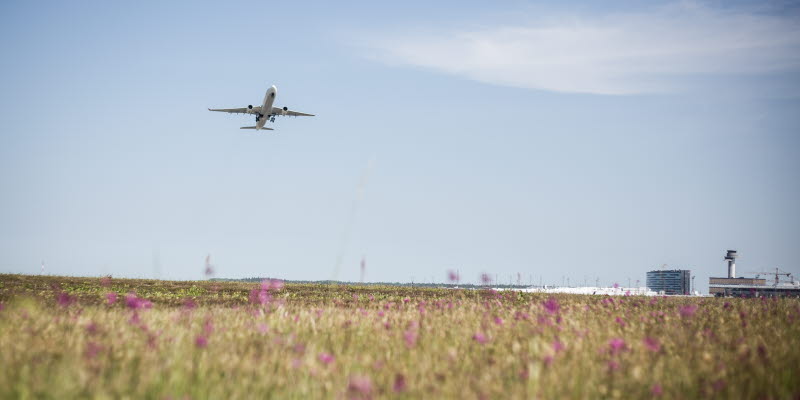
One public tool available for use is Flightradar24.com.
The Webtrak tool that we previously made available here on our website is being reviewed, and we are exploring the possibilities of using other data sources. This is in order to once again enable people living in the vicinity of our airports to track air traffic movements and link this information to aviation noise measurements where available.